
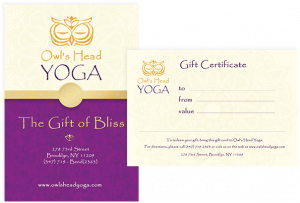
Gift Cards
Give the gift of bliss.
Purchase gift cards online or at the studio. Printed certificates and envelopes available in person.
OnlineIn studioPrinted
Purchase a Gift Card
What the science says about a regular practice.
Thousands of peer-reviewed studies have examined how yoga affects the body and mind. Here is a plain-language summary of what the research consistently finds — and where to explore further.
Yoga has been studied across major institutions including Harvard Medical School, Johns Hopkins, the Mayo Clinic, and the National Institutes of Health (NIH). The body of literature spans thousands of randomized controlled trials, longitudinal studies, and systematic reviews. What follows is a plain-language summary organized by benefit area.
Multiple studies published in Psychoneuroendocrinology and the Journal of Alternative and Complementary Medicine have measured salivary cortisol before and after yoga sessions. Participants consistently showed significant reductions — some studies reporting drops of 20–30% following a single session. Long-term practice produced more stable baseline cortisol levels compared to non-practitioners.
A 2017 meta-analysis in the Journal of Psychiatric Practice (covering 23 randomized controlled trials) concluded that yoga significantly reduced symptoms of depression and anxiety across diverse populations, including those with clinical diagnoses. The effect size was comparable to cognitive-behavioral therapy in mild-to-moderate cases. The NIH now lists yoga as a complementary intervention for anxiety disorders.
Bessel van der Kolk's landmark research at Boston University found that trauma-sensitive yoga was more effective than standard talk therapy alone for women with treatment-resistant PTSD. Published in the Journal of Clinical Psychiatry, the study demonstrated measurable reductions in PTSD symptom scores after 10 weeks of yoga. His book The Body Keeps the Score built on this work and introduced it to a wide audience.
Research in Frontiers in Psychiatry and International Journal of Yoga documents yoga's effect on the vagus nerve — the primary pathway of the parasympathetic nervous system. Breath-linked movement and pranayama increase heart rate variability (HRV), a reliable biomarker of resilience and autonomic balance. Higher HRV is associated with better emotional regulation, lower cardiovascular risk, and improved recovery from exercise.
"The scientific study of yoga demonstrates that mental and physical health are not just closely allied — they are essentially equivalent."— Harvard Health Publishing, Harvard Medical School
A 10-week study in the International Journal of Yoga found significant improvements in flexibility and balance after twice-weekly yoga sessions. Unlike static stretching, yoga's dynamic and held postures affect the fascial network — the connective tissue that wraps every muscle and organ. Research from the Journal of Bodywork and Movement Therapies suggests regular yoga practice remodels fascial layers, reducing chronic tightness and injury risk.
Studies published in the Journal of Strength and Conditioning Research have compared yoga-trained athletes to control groups and found measurable improvements in functional strength, particularly in the posterior chain and stabilizing muscles of the spine and hips. These muscles are often underactivated in traditional gym training but are critical for injury prevention and long-term athletic longevity.
A systematic review in the European Journal of Preventive Cardiology (2014, covering 37 studies) found that yoga reduced LDL cholesterol, resting heart rate, and systolic blood pressure comparably to conventional aerobic exercise. The American Heart Association has since recognized yoga as a viable adjunctive treatment for cardiovascular risk factors in its clinical guidelines.
The Annals of Internal Medicine published a randomized controlled trial in 2017 showing yoga was as effective as physical therapy for chronic low back pain — and superior to standard medical care alone. A Cochrane Review of 12 trials concluded yoga produces clinically significant reductions in pain intensity and functional disability, with benefits maintained at 6-month follow-up.
Research published in Integrative Cancer Therapies and the Journal of Clinical Oncology found that yoga significantly improved sleep quality, sleep efficiency, and daytime fatigue — even in populations with clinical sleep disorders. A Harvard-affiliated study of older adults found that 8 weeks of daily yoga improved sleep onset, total sleep time, and morning energy levels more than a sleep hygiene education group.
Studies in the Journal of Sports Science & Medicine demonstrate that yoga reduces muscle soreness and accelerates recovery between training sessions by improving lymphatic circulation and reducing systemic inflammation markers (including CRP and IL-6). Elite programs in the NBA, NFL, and Olympic sports now routinely incorporate yoga into athlete recovery protocols for this reason.
A 2015 study from UCLA published in the Journal of Alzheimer's Disease found that a 3-month Kundalini yoga and Kirtan Kriya meditation program produced greater improvements in memory and executive function than memory enhancement training — and measurably increased cortical thickness in areas associated with attention and interoception. Chronic stress shrinks the hippocampus; yoga's cortisol-lowering effect appears to reverse this process over time.
fMRI research published in Frontiers in Human Neuroscience compared long-term yoga practitioners to non-practitioners and found greater grey matter volume in the prefrontal cortex — the region governing attention, impulse control, and decision-making. Even short-term interventions (8–12 weeks) produced measurable improvements in sustained attention and reaction time compared to control groups.
A growing body of research in Complementary Therapies in Clinical Practice documents yoga's benefit for children and adults with ADHD. Yoga's breath-movement coupling trains the attentional networks of the brain in a way that closely mirrors the cognitive demands of tasks requiring sustained focus. Several studies have used it as an adjunct to medication, showing additive benefits on symptom severity.
Longitudinal data from the Journal of Gerontology and Age and Ageing find that regular yoga practice is associated with slower cognitive decline in aging adults — with particularly strong effects on visuospatial processing and verbal memory. Researchers attribute this to a combination of BDNF (brain-derived neurotrophic factor) elevation, stress hormone reduction, and the demanding proprioceptive challenges yoga places on the nervous system.
Studies in Complementary Therapies in Clinical Practice and the Journal of Developmental & Behavioral Pediatrics show that school-based yoga programs improve attention, working memory, and classroom behavior. Children who participated in twice-weekly yoga classes demonstrated significant improvements in executive function scores compared to control groups — with effects lasting through the school year.
Research from Boston Children's Hospital and Columbia University documents yoga's role in developing emotional regulation in children aged 5–12. Breath awareness and body-scan techniques teach children to recognize and respond to internal states — skills shown to reduce aggressive behavior, improve peer relationships, and build long-term emotional resilience.
Explore our Kids Yoga program →
"Yoga, when practiced regularly, produces changes in the brain that are measurable on MRI — and the changes are consistent with improved mental health, resilience, and cognitive function."— Frontiers in Human Neuroscience, 2019
Whether you run, lift, play sports, or simply want to move better — yoga builds the foundation that makes every activity feel easier and last longer.
Open tight hips and hamstrings, strengthen the stabilizers that protect your knees, and train the breath control that carries you through long miles.
Yoga fills the gaps in traditional training — mobility, core stability, and body awareness that make every rep safer and more effective.
Balance, coordination, and focused breathing give athletes a mental and physical edge — whether you're on the field, court, or in the water.
A consistent yoga practice sharpens focus, lowers stress, and builds the calm that helps you perform — at work, at home, and everywhere in between.
Ready to experience these benefits firsthand?
Purchase gift cards online or at the studio. Printed certificates and envelopes available in person.
278 73rd Street, Brooklyn, NY 11209